On the Meaning of Islam
فِي بَيَانِ مَعْنَى الْإِسْلَامِ مِنَ الْكِتَابِ وَالسُّنَّةِ وَأَقْوَالِ السَّلَفِ
-
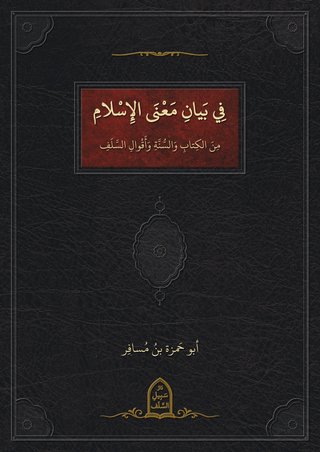 Arabic edition as PDF (214 pages)Published: 1442 AH 2nd edition: 1448 AH
Arabic full text to read online
Black-and-white print version
On the Meaning of Islam – from the Qur'an, the Sunnah and the Statements of the Salaf is available in Arabic. This page gives the key facts about the book, a comparison with the English edition and the chapters. The preface has been translated into English in full, together with some important points from the closing words of the book. This description is also provided in all the other languages of the website.
The Book at a Glance
- Edition: second, extensively revised and expanded edition, 1448 AH (2026); first edition 1442 AH (2020). Shorter versions came before the book; how it came about is described in the translated preface. Besides the colour edition, there is a black-and-white print version.
- Structure: preface, chapters with their sections, closing words with five further questions, five indexes. The texts cited are set apart from the rest of the text and numbered throughout.
- Sources: Only early scholars are quoted, and this is deliberate. The index of authors cited shows it too: it lists 67 authors, the last of whom, ad-Diya' al-Maqdisi, died in 643 AH.
Comparison with the English Edition
The English book The Doctrine of Monotheism (full text) is a translation of the German edition, which grew out of this book. The Arabic edition goes into more detail in many respects:
- More evidence: More Ayat, Hadiths and statements of the early scholars are given on each point.
- Detailed Takhrij: For many texts, the book shows where and in which wordings they are narrated, so the different narrations of a text are set out one by one.
- Explanations of the language: Many words are explained from the works of the early scholars of Arabic. Here, too, care was taken to draw on early authors wherever possible. The book also points out the different readings of the Qur'an, again quoted from the earliest sources available.
- Additional and expanded chapters:
- What Shirk really is: The book deals in more detail with the claim of some that Shirk exists only in Rububiyyah: whoever merely asks the dead for something, they say, does not commit Shirk as long as he does not believe that the one called upon gives independently of Allah. The book shows, on the contrary, that worshipping another besides Allah is in itself Shirk, and that in the Shari'ah and in the language a thing is named after what is most important in it (Chapter 3, sections 6 and 7; Chapter 14, section 7).
- Knowledge of Allah and His Tawhid as the best of all knowledge (Chapter 1)
- The place of “La ilaha illa Allah” in the religion: Tawhid as the foundation of Islam, and the conditions of the Shahadah (Chapter 4)
- The right of Allah over His servants, and the Hunafa' before the Prophet صلى الله عليه وسلم was sent, with the hadith of 'Amr ibn 'Abasah (Chapter 9)
- How the Mushrikun among the Arabs and non-Arabs knew the meaning of the Shahadah, including the stories of Abu Talib, Heraclius and an-Najashi (the Negus); with 14 sections, this is the longest chapter (Chapter 10)
- Islam as the religion of all the prophets (Chapter 11)
- The Fitrah and the covenant (Mithaq) that Allah took from people (Chapter 13)
- As well as individual sections in other chapters: how 'Ali رضي الله عنه accepted Islam (Chapter 2), the hadith of Salman al-Farisi رضي الله عنه (Chapter 16; explained in detail in a separate work), the questioning by the two angels in the grave, and that the first thing a child is taught is belief in Allah and renouncing the Taghut (Chapter 17)
- Full vowelling: The Arabic edition is vowelled throughout, following a system of its own. The texts quoted, that is, Hadiths and statements of the scholars, are fully vowelled, and the Ayat are written in the Rasm of the Mushaf. The author's own text carries only what is needed to read it correctly: the word endings that show the I'rab, every Shaddah, the difference between words such as مِن and مَن, places that could otherwise be read in more than one way (such as active and passive), and names and explained words in full. This keeps the text calm and uncluttered on the page, while leaving no doubt about how it is to be read.
- Scholarly indexes:
- Ayat and Tafsir of the Salaf: the Ayat in the order of the Mushaf, with the Salaf whose Tafsir of each Ayah is quoted listed beneath it, in order of the year of their death
- Hadiths: in alphabetical order of their opening words, with the Companion who narrated each one
- Athar: the statements of the Salaf who died before the year 200 AH, in order of the year of their death
- Sources: 91 works, divided into Tafsir, readings and works of narration on the one hand and dictionaries and linguistics on the other, in order of the year of the authors' death, each with the edition used
- Authors cited: in order of the year of their death
The English edition, for its part, contains sections written to help its readers: an introduction to the role of transmission in religions, with a comparison with Judaism and Christianity, and to the sources of Islam; explanations of basic terms, such as the division of Tawhid; a chapter on faulty methods of deriving evidence, including the Hadiths about Dhatu Anwat and about Mu'adh, which the Arabic book only mentions because they need to be answered separately; and also a transcription table and a chronological index of early Islamic authors. A glossary is provided on the book's summary page.
Translation of the Arabic Preface
All praise is due to Allah, and may blessings and peace be upon the Messenger of Allah, his family, his Companions and all who stand by him. To proceed:
This is a treatise on the meaning of Islam. In it I have kept to the texts of the Qur'an and the Sunnah and to those statements of the Salaf that help to understand them. These texts show clearly that Islam means worshipping Allah alone and not associating anything with Him in what belongs to Him alone سبحانه وتعالى: in His Rububiyyah, His Names and Attributes, and His Uluhiyyah. They also show that Islam is the religion of Ibrahim, the Hanifiyyah, that it is the religion of all the prophets and messengers عليهم السلام, and that it means believing in Allah and renouncing the Taghut.
Today the meaning of Islam has become unclear to many people. Some go to extremes and accuse Muslims of Kufr and of having left the religion; others count as Muslims people in whom its meaning is not found. The evidence in this book is therefore meant to make two things clear. Whoever fulfils the meaning of Islam and does nothing that contradicts it is a Muslim, with all the rights and duties of a Muslim. Whoever, on the other hand, associates partners with Allah through major Shirk, and in whom this Shirk is truly present, is not a Muslim in any way – unless he repents of it and gives it up. This does not apply to minor Shirk, nor to words and deeds that can be understood in more than one way.
Some scholars have summed this up in a single sentence worth reflecting on: “Islam and Shirk are complete opposites. They never come together.” It makes no difference here whether someone who commits major Shirk counts himself as belonging to Islam or is one of the other Mushrikun. For how can someone fulfil “La ilaha illa Allah” when he has taken two to worship and made partners for Allah in worship?
So the Mushrik, whoever he may be, lacks four things:
- the reality of Islam,
- the name of Islam,
- the legal rulings that apply to Muslims in this world,
- the legal rulings that apply to Muslims in the Hereafter.
Many people today have lost sight of these facts. As a result, it has become widespread to call various kinds of Mushrikun Muslims, so much so that anyone who judges them as the Qur'an and the Sunnah require is accused of going to extremes.
Those who oppose this principle do so in different ways: some consider certain Mushrikun to be Muslims in every respect, while others deny them only some of these rulings. We must therefore go back to the sources of this principle and establish it firmly.
From this principle, in turn, important questions branch off, and each of them should be discussed on its own once the principle itself has been settled. The first is the question of what Shirk really is, together with the claim of some that Shirk exists only in Rububiyyah: that merely asking the dead for something is not Shirk unless it goes with the belief that the one called upon gives independently of Allah, the Exalted. I have dealt with this in several places in this book.1
These questions also include the Hadiths about the people of the Fatrah and their test, the question of when the Hujjah has been established against someone, and the ruling on a person who declares certain Mushrikun to be Muslims while knowing full well what their state is. I have touched on them as far as they relate to the principle.2
The same goes for the objections raised against this principle. They are many, and nearly all of them come from following what is ambiguous in the texts and in the statements of scholars: for example, using the Hadith of Dhatu Anwat and the Hadith of Mu'adh ibnu Jabal prostrating to the Prophet صلى الله عليه وسلم as evidence that someone who has fallen into major Shirk can still be a Muslim, or treating the statements of some scholars as proof in themselves and using them against what the Qur'an and the Sunnah show. The statements of scholars need proof; they are not themselves the proof. These objections, too, need to be answered separately. I have deliberately not dealt with them here, because the principle is first established from its clear evidence, and only then is what is ambiguous referred back to it.
I have set out these questions in somewhat more detail in the closing words. They are all important, but one should turn to them only after the principle from which they branch off has been discussed. What makes them hard to understand for many people is precisely that they do not keep to this order and mix the questions up.
The Evidence for Islam Is Abundant and Strong
The meaning of Islam on which this religion is built is the most important thing a person must learn and act on. That is why the evidence explaining it is beyond counting: it is plentiful, each piece supports the other, and it was well known to the early Muslims. What of it is in the Book of Allah is the foundation, and in it lies the clear and plain explanation. As for the Hadiths, nearly all of them are among the strongest reports narrated with a chain of transmission; the scholars of Hadith accepted them and recognised them as proof. If, in this context, statements of the Salaf on Tafsir and the like are also quoted whose chains have a slight weakness, they serve only to make the established principle clearer to the reader and to confirm it, not to establish it. For the principle of Islam does not depend on being proven by reports of this kind; this should be understood.3 The same applies to statements quoted to explain the meanings of Arabic words, or to show that what this book sets out about the meaning of Islam is what everyone else who was occupied with knowledge in those times also held.
How This Book Came About
This book began more than twenty years ago as a treatise of a few pages. I sent it to an Egyptian Shaykh to draw his attention to some points about the reality of Islam and Shirk that have become unclear to some people. The treatise was then expanded until it became a book. Through all these stages I was keen to gather the evidence from the Qur'an and the Sunnah and to rely on it, until I decided to add to each piece of evidence what the Salaf of this Ummah had said in explaining it. For they had a firm knowledge of the Qur'an, the Sunnah and the speech of the Arabs that no one after them has reached, whoever he may be.4 In this form the book appeared in its first edition, under pressure of time and in difficult circumstances. Shortly afterwards I resolved to revise it, but for years I was not able to, until Allah, by His grace, enabled me to make up for this in the present edition.
In this edition the layout and design have changed a great deal, and the book has been revised in many places: the texts quoted were checked against their printed sources, and evidence was added in some places, in the hope that this important subject comes closer to the accuracy and care it deserves. Indexes were also added at the end to make the book complete in its benefit.
Method of the Book
For my quotations I relied on the editions available in al-Maktabah ash-Shamilah, so that the reader can easily look them up. I have not given volume, page or Hadith numbers, because they differ from one edition to another; a text can be found there by searching for its wording. Where a work has several editions, I chose the one generally regarded as reliable by those who know this field, and I named it under each work in the index of sources. I have mentioned differences between manuscripts only where they change the meaning. Where a Hadith is in both Sahih collections from the same Companion, I write “muttafaqun 'alayh” after the reference, meaning that al-Bukhari and Muslim both narrated it, even if their wording differs or one of them has some versions the other does not have; the wording is that of the source named. Likewise, where possible, I briefly mention after the reference what is narrated outside the two Sahih collections with the same or similar wording, for example “and likewise in …”; longer details are given in the footnote.
I have left out the chains of transmission for brevity, so a quotation begins with the Companion or with whoever made the statement. Where a chain has been left out in the middle of a quotation, or something that could confuse the reader remained after leaving it out, I have put three dots (…) in its place. I have fully vowelled the texts quoted, but in my own text only what might be misread. The Ayat are written in the Rasm of the 'Uthmani Masahif in the narration of Hafs from 'Asim; where another reading was needed, I wrote it in the Rasm of the Mushaf of that narration.
At times I quote people who deviated in 'Aqidah, mostly to explain the language, because its meanings were known and widespread in the first centuries. Occasionally I also mention one of them in a footnote for a wording not found with anyone else. Mentioning them does not mean that I vouch for them, nor that I rely on them as proof in any matter of the religion.
I have numbered the chapters, the sections within each chapter and the quoted texts set apart in frames consecutively. I have not numbered the Ayat, because they are known by their place in the Mushaf; where they appear in the book can be found in the Index of Ayat and the Tafsir of the Salaf.
The book contains 172 Ayat and 212 numbered texts, of which 79 are Hadiths and 96 are statements of the early scholars on Tafsir.
At the end of this preface, it only remains for me to thank Allah, the Exalted, for enabling me to complete this book, and then all those among my family and the brothers who helped me with it; may Allah be good to them and reward them with good. May Allah also be good to those from whom I learned and gained knowledge that has benefited me in this book or elsewhere, as they were good to me. And as for any of them who oppose what the Qur'an, the Sunnah and the statements of the Salaf have established on this principle and others like it, I ask Allah to guide both me and them to what is right and to the straight path. Amin.
… So much for this, and Allah knows best. With Allah, the Exalted, lie success and being guided to what is right. It is Allah whom I ask for help, and Him I call upon to grant me success in what He loves and is pleased with, to make this book of benefit to His servants, and to make our intentions sincerely for His noble Face alone. Amin.
Written by Abu Hamzah ibnu Musafir
Footnotes to the Preface
- See Chapter 3, sections 6 (Drawing attention to the important principle in the Shari'ah and in the language that a thing is named after what is most important in it) and 7 (Whoever says that worship is not Shirk unless one associates partners with Allah in Rububiyyah), and Chapter 14, section 7 (The meaning of the word Shirk). ↩
- The Hadiths about the people of the Fatrah are in Chapter 18, and the ruling on a person who declares certain Mushrikun to be Muslims is in Chapter 20. ↩
- It should be pointed out here that when the early Salaf used Hadiths and Athar as proof, they did not look only at the strength of the chain and whether it was free of weakening defects. They also took into account many other indications that they knew and had mastered. Many people today overlook these when they divide the books of the Salaf into sahih and da'if, assuming that the Salaf did not know about the weaknesses in their chains, even though they explained their approach themselves. The Imams distinguished between chains and did not judge them all alike: they treated what was narrated on Tafsir differently from reports about what is lawful and unlawful. See the chapter A Word on What the Editors Have Said about the Chains of This Tafsir and on How the Scholars of the Salaf Treated the Chains of Tafsir in the treatise Explanation of the Preface to the Tafsir of Ibnu Abi Hatim ar-Razi. On top of this come the reports that the Salaf accepted, that they all agreed to use as proof and that concerned the most important matters of the religion, such as the reports quoted to explain the meaning of Islam. ↩
- Al-Hasan al-Basri said about the Companions of the Messenger of Allah صلى الله عليه وسلم: “They were the purest of heart in this Ummah, the deepest in knowledge and the least given to affectation, a people whom Allah chose to accompany His Prophet صلى الله عليه وسلم …” Narrated by Ibnu 'Abd al-Barr in Jami'u Bayani l-'Ilmi wa-Fadlih. He also narrates it in a similar form from Qatadah from Ibnu Mas'ud, where it says: “So recognise their merit and follow them in their footsteps.” Qatadah, however, did not live to meet Ibnu Mas'ud. ↩
Translated from the Arabic Closing Words: Five Further Questions
In the preface I mentioned that questions branch off from this principle, and that each of them should be examined on its own in the way the principle has been examined here. I list them here in somewhat more detail:
First question: What is Shirk, really? This question needs attention, for it is the one that opponents raised against those who call to Tawhid. They would say to them, for example: “We accept that the Mushrik is not a Muslim. But the Shirk that takes a person out of Islam concerns only Rububiyyah; merely asking the dead for something is not Shirk unless it goes with the belief that the one called upon gives independently of Allah, the Exalted.” How weighty and important this question is needs no explanation. And yet, as said before, many people have not even come as far as accepting that major Shirk destroys Islam at its root. Instead, they mix the two up, see no problem in imagining a “Muslim Mushrik” and argue in its defence. I have already dealt with this in this book and mentioned some important points about it, but the matter needs a detailed study of its own.
Second question: The Hadiths about the people of the Fatrah and their test,5 and whether punishment in the Hereafter depends solely on the Hujjah of the messengers having been established. In other words: can someone whom the call of a messenger did not reach, or who was not able to understand the message at all, and who died in Shirk while of sound mind, that is, accountable, and adult, be saved in that test?
This question should be studied at a later stage. I have only mentioned it in this book because it relates to an important point in the question of Islam and Shirk: some people use it as proof that a Mushrik can be regarded as a Muslim in this world. To this it should be said: by these people's own understanding, these Hadiths would in fact be among the clearest proofs that whoever died in Shirk was never a Muslim in this world. For this test is not meant for Muslims at all; by consensus, no Muslim is tested in this way.
Third question: When has the Hujjah been established? To this it should be said: at most, this question comes down to whether this Mushrik is among those who will be tested or not. The question is not whether he was a Muslim. These are two entirely different things.
Fourth question: Widening the circle of those against whom the Hujjah has not been established. This question branches off from the previous one. Some people widen this circle so far that it even includes someone who knows Arabic, has memorised the Qur'an and lives in the cities of the Islamic world. They say that the Hujjah is not established against him until he has truly understood, after long discussions with a number of scholars in different fields of knowledge. This claim was unknown to the Imams of Islam.6 But it is a separate question, to be studied on its own; it changes nothing about the fact that a person who commits major Shirk cannot be a Muslim at the same time.
Fifth question: The ruling on a person who declares certain Mushrikun to be Muslims while knowing full well what their state is and that they commit major Shirk. This question, too, branches off from the principle. Its cases and aspects should be studied with care, without rushing to judgement. I have pointed to it in the preceding chapters7 because it relates to the principle, but it needs a study of its own.
As for the objections raised against this principle, such as the Hadith of Dhatu Anwat, the Hadith of Mu'adh's prostration, or treating the statements of some scholars as proof in themselves, nearly all of them come from following what is ambiguous. They are to be answered separately, by referring everything ambiguous back to the clear evidence established here.
Footnotes to the Closing Words
- See also Chapter 18. ↩
- See Chapter 10. ↩
- See also Chapter 20 and Chapter 10 as a whole, especially section 5 (that all the prophets and their followers distinguished the Muslim from the Mushrik and dissociated themselves from the Mushrikun, with the Ayah about the excellent example in Ibrahim and those with him, sura al-Mumtahanah, 60:4) and the sections after it. ↩