Explanation of the Preface to the Tafsir of Ibnu Abi Hatim ar-Razi (Summary)
-
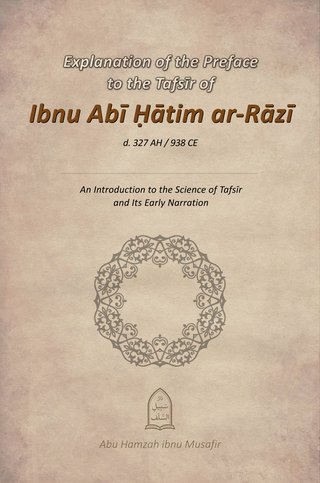 Explanation of the Preface to the Tafsir of Ibnu Abi Hatim ar-Razi An Introduction to the Science of Tafsir and Its Early Narration
67 pagesDownload PDF
What Is Explanation of the Preface to the Tafsir of Ibnu Abi Hatim ar-Razi About?
The Tafsir (Qur'anic exegesis) of Ibnu Abi Hatim ar-Razi (d. 327 AH) is one of the earliest comprehensive works of its kind, and much of it has survived to this day. In a short preface, Ibnu Abi Hatim describes how he compiled his work. In doing so, he offers insight into Tafsir based on narrations (At-Tafsiru l-Ma'thur), on which all interpretation of the Qur'an rests. The book translates this preface and explains it sentence by sentence.
Before the explanation comes a detailed introduction to the science of Tafsir and the way it was passed on. The book also gives the biography of Ibnu Abi Hatim ar-Razi and of his two most important teachers, Abu Hatim ar-Razi and Abu Zur'ah ar-Razi, and tells the story of the manuscripts and of today's printed editions of the work. It closes with a brief look at four chains of narration that Ibnu Abi Hatim himself names at the end of his preface as examples.
Key Points of Explanation of the Preface to the Tafsir of Ibnu Abi Hatim ar-Razi
- Together with Tafsir at-Tabari, the Tafsir of Ibnu Abi Hatim ar-Razi is one of the most comprehensive and best-preserved works of Tafsir from the early Islamic period.
- At-Tafsiru l-Ma'thur (Tafsir based on narrations) is the foundation of all interpretation of the Qur'an. At-Tafsiru bi-r-Ra'y (Tafsir based on one's own view or opinion) becomes a problem above all when it ignores the interpretations handed down from the Salaf.
- When Ibnu Abi Hatim speaks in his preface of “the most correct chains of narration”, he means this relative to the field of Tafsir, not to the science of narration as a whole.
- Tadabbur (reflecting on a verse of the Qur'an) and Istinbat (drawing out a meaning of the Qur'an that is not obvious) are not wrong in themselves. They only become a problem when they are cut off from what the Salaf narrated.
- The narration of Tafsir followed standards of its own, different from those of Hadith science in general: the early scholars were strict about chains of narration in legal rulings, but comparatively lenient in Tafsir.
- Even so, Tafsir was as a rule not accepted from known liars or extremely weak narrators, such as Muhammad ibnu s-Sa'ib al-Kalbi. Ibnu Abi Hatim ar-Razi also did not narrate from Muqatil ibnu Sulayman.
- The early schools of Tafsir go back to individual Companions of the Prophet صلى الله عليه وسلم who taught Tafsir in the major cities of the Islamic empire, among them Ibnu 'Abbas in Makkah and Ibnu Mas'ud in Kufa.
- According to the well-known statement of Ibnu 'Abbas, Tafsir is of four kinds: what the Arabs know from their language, what no one is excused for not knowing, what the scholars know, and what no one knows except Allah.
- Ibnu Abi Hatim ar-Razi arranged the narrations by rank: first the words of the Prophet صلى الله عليه وسلم himself, then those of the Sahabah according to their standing, then those of the Tabi'in and the generations after them.
- Rejecting narrated statements of Tafsir on the grounds of weak chains or of supposed Isra'iliyyat has become more and more common over roughly the past fifty years. This departs from the way the early scholars worked.
- The larger printed edition available today is more complete than the older one, but its comments are criticised for how they treat the narrations of the Salaf.
- At the end of his preface, Ibnu Abi Hatim ar-Razi shortens four chains of narration that recur often in his work, those from Abu l-'Aliyah, As-Suddi, Ar-Rabi' ibnu Anas and Muqatil ibnu Hayyan, and refers to them as examples.
Outline of the Book
- Foreword: how the book grew out of a lecture series from 2021 and 2022, what it sets out to do, and notes on the simplified transcription.
- About the Tafsir of Ibnu Abi Hatim ar-Razi and its author: the biography of Ibnu Abi Hatim ar-Razi and of his two teachers Abu Hatim ar-Razi and Abu Zur'ah ar-Razi, and background on the manuscripts and the two printed editions in use today.
- General introduction to the science of Tafsir and its narration: the early works of Tafsir, the difference between At-Tafsiru l-Ma'thur and At-Tafsiru bi-r-Ra'y, the most important schools of Tafsir, how the Sunnah explains the Qur'an, the statement of Ibnu 'Abbas on the four kinds of Tafsir, and why the scholars were more lenient with chains of narration in Tafsir.
- Explanation of the preface of Ibnu Abi Hatim ar-Razi: a sentence-by-sentence translation and explanation of the preface itself, including what “the most correct chains of narration” means and the order in which Ibnu Abi Hatim ar-Razi arranged the narrators he drew on.
- Conclusion of the preface – examples of chains of narration: a look at the four routes of narration that Ibnu Abi Hatim ar-Razi names as examples, with notes on wordings of narration such as “haddathana” and “'an”.
- Conclusion: what the book set out to show, followed by the list of sources.
Key Terms (Glossary)
- Al-Jarhu wa-t-Ta'dil / 'Ilmu r-Rijal
- The science of assessing the narrators of Hadith for their trustworthiness and reliability.
- Atba'u t-Tabi'in
- The generation that followed the Tabi'in, the third generation after the Sahabah.
- At-Tafsiru bi-r-Ra'y
- Interpreting the Qur'an by one's own opinion; a problem as soon as it ignores the interpretations handed down from the Salaf.
- At-Tafsiru l-Ma'thur
- Tafsir passed on through narrations from the Salaf; the foundation of all interpretation of the Qur'an.
- Hadith / Isnad
- A transmitted report from the Prophet صلى الله عليه وسلم, or its chain of transmission — the central tool of verification in Islamic Hadith science.
- Isra'iliyyat
- Stories from the Ahlu l-Kitab (Jews and Christians), mostly of Jewish origin.
- Istinbat
- Drawing out a meaning from a passage of the Qur'an that is not obvious, for example in legal questions about new matters.
- Matn
- The text of a narration, that is, its content without the chain of narration (Isnad).
- Mursal (plural: Marasil)
- A narration in which the first link of the chain, usually the Companion from whom a Tabi'i narrates, is not named.
- Sahabah / Tabi'in
- The Companions of the Prophet (Sahabah) and the generation after them (Tabi'in), who still lived at the same time as the Sahabah.
- Salaf
- The early, righteous generations – and in particular their scholars.
- Tadabbur
- Reflecting deeply on a verse of the Qur'an.
- Tadlis / Mudallis
- The practice of a narrator leaving out the narrator before him in the chain, using wording that does not make clear whether he heard the report directly; a narrator who does this is called a Mudallis.
- Tafsir
- The science of Qur'anic exegesis, or the interpretation of a verse of the Qur'an itself.
Methodology and Sources
The explanation follows the methods of Hadith and Tafsir scholarship: each sentence of Ibnu Abi Hatim ar-Razi's preface is given in the original Arabic and in translation, and then explained, drawing among others on statements of other early scholars such as Ahmad ibnu Hanbal, Yahya ibnu Sa'id al-Qattan and Al-Khatibu l-Baghdadi. The quotations follow the editions in the digital library al-Maktabatu sh-Shamilah. Works cited include the two Sahih collections of Al-Bukhari and Muslim, Tafsir at-Tabari, Al-Jarhu wa-t-Ta'dil and Al-'Ilal of Ibnu Abi Hatim ar-Razi himself, Al-Kamilu fi Du'afa'i r-Rijal of Ibnu 'Adi al-Jurjani, and Al-Jami'u li-Akhlaqi r-Rawi wa-Adabi s-Sami', Al-Kifayah fi 'Ilmi r-Riwayah and Tarikhu Baghdad of Al-Khatibu l-Baghdadi.
Who Is Explanation of the Preface to the Tafsir of Ibnu Abi Hatim ar-Razi Relevant For?
The book is written for English-speaking readers, Muslim or not, who want to understand the Qur'an and its interpretation (Tafsir) more closely, and for students of the Islamic sciences looking for a sound introduction to the science of Tafsir and to how the early scholars passed it on.
Further Reading
- Explanation of the Preface to the Tafsir of Ibnu Abi Hatim ar-Razi – the book to read online, chapter by chapter.
- The Arabic book on the preface to the Tafsir of Ibnu Abi Hatim ar-Razi – English description with the translated foreword.
Sources
Sorted by date of death (given as the Hijri year followed by the Common Era year).